
Introduction

The Pre-Surface Water and Ocean Topography (Pre-SWOT) Hydrology is part of NASA's Making Earth System Data Records for Use in Research Environments (MEaSUREs) Program. MEaSUREs develops consistent global- and continental-scale Earth System Data Records (ESDRs) by supporting projects that produce data using proven algorithms and input.

The Pre-SWOT Hydrology project provides precursor SWOT products for global hydrologic changes from a combination of satellite imagery and multi-mission satellite radar altimetry data, including virtual river station heights, lake/reservoir surface water area extent, and lake/reservoir water height spanning from 1992 (TOPEX-Poseidon launch) to present, with the potential to be extended up to the launch of the SWOT mission planned for 2021. 

This project focuses on the development of ESDRs for surface-water storage change dynamics throughout the world with up to 349 targets, especially at resolutions and quality relevant to human use and which are largely absent from current global hydrology models. Lakes and reservoirs (larger than ~100 km2) and rivers (wider than ~900 m) are included in the initial project scope, with an emphasis on targets that were clearly distinguishable from other nearby water bodies for improved accuracy of both elevation and surface area estimates. More specifically, we use data produced by multiple satellite altimetry missions (TOPEX-Poseidon, Jason-1, Jason-2, Jason-3, and ENVISAT) beginning in 1992 onwards, with surface water area extent estimates derived from Terra/Aqua MODIS from 2000 onwards. Surface-water storage change dynamics were produced using both surface area and altimetry (i.e., hypsometry) and was able to be estimated during periods when either of the variables was not available, provided that there was a strong surface area/altimetry relationship during overlapping periods.
Image
Image Caption

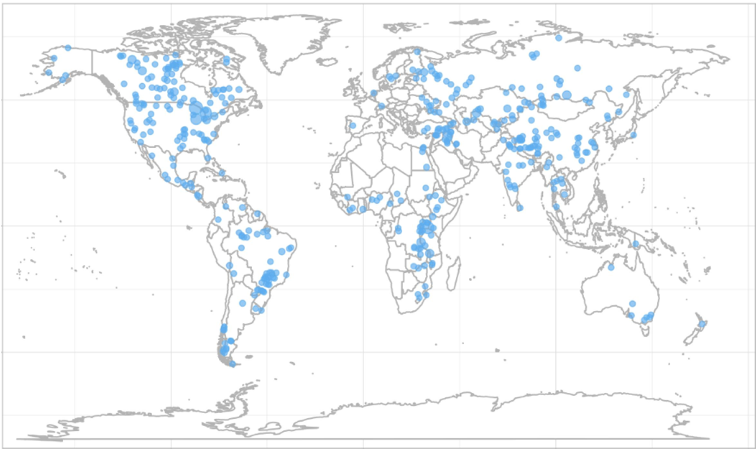
Location of the global lake and reservoir targets (blue bubbles, by average lake/reservoir size). Credit: PO.DAAC

Image
Image Caption

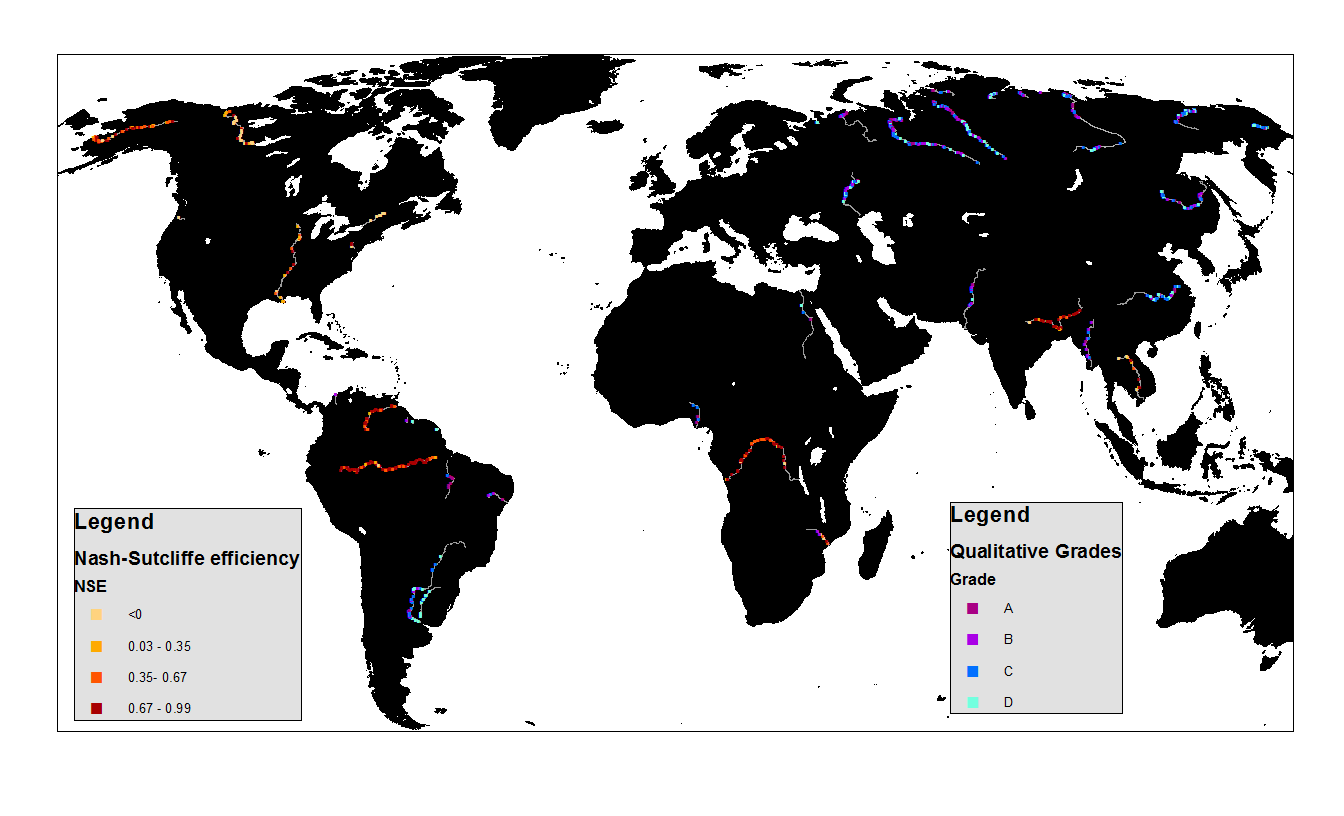
The Global River Radar Altimeter Time Series (GRRATS) dataset and evaluation results. Maximum NSE (best fit) plotted in yellow to red (shown on all rivers with gage data) and qualitative grades plotted in teal to dark purple. In both cases, darker colors indicate better evaluation results. Credit: PO.DAAC

Project Objectives

The contents of this project span three objectives:

  1. Produce pre-SWOT data records of reservoir, large lake, and river height change for as many of the largest global reservoirs and lakes as possible, based on the data from all available altimeter data spanning the period 1992-2018. For altimetry, G-REALM10 was used as a primary elevation source (which merges T/P, Jason-1, Jason-2, Jason-3, as shown in figure 2a and supplemented with DAHITI, LEGOS’s Hydroweb data, and G-REALM35 whenever G-REALM10 was unavailable for a specific target during the study period (1992-2018)).
  2. Produce pre-SWOT data records of surface area for as many of the world’s largest reservoirs, lakes, and rivers as possible based on data from Terra/Aqua MODIS satellite optical imagery (nominal monthly time intervals), spanning 2000-2016. The purpose of these area products is to provide satellite derived surface area data in a form that’s recognizable to the observational community.
  3. Produce model-based estimates of reservoir, lake, and river storage change for target water bodies using a combination of altimeter and surface area data (e.g. hypsometry). Elevation-area relationships were derived from these data for each waterbody, allowing us to create model based volume estimates.

Animation

Remote video URL
This animation depicts simulated surface water features for a series of consecutive SWOT passes over North America. They closely resemble Level 2 terrestrial hydrology datasets that will be generated by SWOT. The feature datasets are stored in shapefiles containing river reaches (polylines; approximately 10 km long) and nodes (points; approximately 200 m spacing) identified in the Prior River Database (PRD), as well as lake features identified in Prior Lake Database (PLD). Credit: PO.DAAC

What Makes This Dataset Unique?

Surface water dynamics information is necessary in order to support various monitoring programs as well as scientific objectives, however is often scarce and difficult to access in many regions due to geographic constraints, budgetary limitations, or closed data policies. As a result our ability to understand the global surface water balance is limited (Lettenmaier and Famiglietti, 2006, Gao, 2015). The recent advent of freely available remotely sensed data products has now provided users with access to high-quality, analysis-ready data at adequate spatial and temporal resolutions for surface water dynamic analysis. As a result the hydrology community has been active in estimation surface area, surface height, and/or storage metrics for lakes and reservoirs for various regions, however there is no comprehensive, long term, and publicly available database of lake and reservoir altimetry, area, and storage time series estimates. It is in this context that this project has produced those datasets with the highest feasible quality data using pre-SWOT remotely sensed data.

Documentation

Lake Heights Users' Guide

Lake Surface Area Users' Guide

Lake Storage Users' Guide

River Heights Users' Guide

Data Access

Dataset NameProcessing
Level
Start/StopFormat
Pre SWOT Hydrology Global Lake/Reservoir Storage Time Series V241992-Sep-25 to 2019-Dec-23netCDF-4
Pre SWOT Hydrology Global Lake/Reservoir Surface Inland Water Height GREALM V.221992-Sep-25 to 2019-Dec-23netCDF-4
Pre SWOT Hydrology GRRATS Virtual Station River Heights Version 221992-Apr-06 to 2018-Apr-20netCDF-4
Pre SWOT Hydrology GRRATS Daily River Heights and Storage Version 221992-Apr-06 to 2018-Apr-20netCDF-4
Pre SWOT Hydrology Global Lake/Reservoir Surface Inland Water Area Extent V232000-Feb-18 to 2016-Oct-15netCDF-4

Citations

Channel water storage anomalies: A new remotely sensed measurement for global river analysis, https://doi.org/10.1002/essoar.10504533.1

Estimation of inter-satellite and inter-track biases of satellite altimetry missions over lakes and reservoirs using surface area from satellite imagery, University of Stuttgart, https://doi.org/10.18419/opus-12923

Satellite-Based Surface Water Storage Estimation: Its History, Current Status, and Future Prospects, IEEE Geoscience and Remote Sensing Magazine, https://doi.org/10.1109/MGRS.2022.3175159

High-resolution water level and storage variation datasets for 338 reservoirs in China during 2010–2021, Earth System Science Data, https://doi.org/10.5194/essd-14-5671-2022

GloLakes: a database of global lake water storage dynamics from 1984 to present derived using laser and radar altimetry and optical remote sensing, https://doi.org/10.5194/essd-2022-266